🇬🇧This meeting should (and could) have been an email (short version)
How to save money and accidentally make the green transition happen in the right way — and with no extra costs
We have been talking about the “green transition” for years now.
And if you look at the amount of money being mobilised, it would be difficult to argue that governments have simply ignored it.
The European Union’s 2021–2027 long-term budget and NextGenerationEU together amount to around €2 trillion. The EU originally committed to directing at least 30% of this envelope towards climate objectives; current Commission projections put the climate contribution at around €662 billion, or 34% of the total. (European Commission)
The Recovery and Resilience Facility alone has a climate target of 37%, and by 2025 Member States had committed more than €275 billion — over 42% of the total estimated RRF costs — to climate objectives. (European Commission)
So yes: there is European money.
But there is an important distinction.
There is not one enormous European pot of money that simply pays for the green transition everywhere.
EU funding is combined with national public budgets, national co-financing, loans, private investment and other financial instruments. The European Commission itself describes the EU budget as one part of a much larger investment effort. And the Recovery and Resilience Facility is temporary: it is due to end in 2026. (European Commission)
Meanwhile, the scale of what Europe still needs is enormous.
Recent ECB analysis estimates that Europe will need to mobilise an additional 2.7–3.7% of EU GDP every year until 2030 to achieve the green transition. Another ECB analysis estimates an average public green-funding gap of around €20 billion per year between 2025 and 2030, even after taking available EU funds into account. (European Central Bank)
And this is where things become interesting.
Because we have spent years telling a very simple story about the green transition:
Governments need to invest more. Far bad countries are making this impossible to happen.
But perhaps this is only part of the story.
For instance China’s clean-energy investment exceeded $625 billion in 2024, almost doubling since 2015. It also achieved its 2030 target for wind and solar capacity six years ahead of schedule. (IEA)
The IEA estimates that China continues to account for nearly 60% of global renewable-capacity growth, while solar PV has become the single largest area of global energy investment. Global solar investment alone was expected to reach around $450 billion in 2025. (IEA)
So the comfortable idea that the green transition is simply a matter of some countries being “serious” and others being “bad” is becoming increasingly difficult to defend.
The reality is much more complicated.
Countries are investing enormous amounts.
But…
But….Some are moving faster than others.
And above, all….Some have BETTER policies than others.
Some have developed impressive financial mechanisms but still perform poorly on other indicators.
And even Europe, despite its considerable investment, has many a country that fail on a daily basis in simple actions that would cost zero extra funds and would reduce enourmously amounts of public money – but also of private citizens.
This means that something else needs to change — and it needs to change now.
Because perhaps the green transition should not only be a question of:
How much more money can governments put into it?
Perhaps we should also ask:
How much waste can governments eliminate without spending more?
In my subscribers post you will find 10 crucial points of our societies that could be improved with 0 extra costs.
It is a reasoning that comes from evidence I have gathered while working and living in different countries and continents.
It is a story of digitalization, of naming things for what they are — crisis and prevention, for instance — and of bringing responsibility to the right side: the side of institutions and those that should educate and inform citizens.
Because sometimes the problem is not that we lack a green solution…or funds.
Sometimes the problem is that we are still organising our societies in ways that were wrong à century ago and continue to worsen whilst making the solution unnecessarily difficult, expensive and wasteful.
And perhaps this is where a different kind of green transition should begin.
There is much more coming in these subscription versions of my posts, and it is a much more sustainable way to read and “get inspired” by my writings (instead of taking here and there and fuel your debate not even quoting me!)
💁🏻♀️
🇫🇷Cette réunion aurait dû (et aurait pu) être un e-mail (version courte).
Comment économiser de l’argent et faire advenir accidentellement la transition verte de la bonne manière — et sans frais supplémentaires
On parle de la « transition verte » depuis des années maintenant.
Et si l’on regarde le montant des sommes mobilisées, il serait difficile de prétendre que les gouvernements l’ont simplement ignorée.
Le budget à long terme 2021–2027 de l’Union européenne et NextGenerationEU s’élèvent ensemble à environ 2 000 milliards d’euros. L’UE s’était initialement engagée à consacrer au moins 30 % de cette enveloppe à des objectifs climatiques ; les projections actuelles de la Commission situent la contribution climatique à environ 662 milliards d’euros, soit 34 % du total. (Commission européenne)
La Facilité pour la reprise et la résilience comporte à elle seule un objectif climatique de 37 %, et d’ici 2025, les États membres avaient engagé plus de 275 milliards d’euros — soit plus de 42 % des coûts totaux estimés de la FRR — pour des objectifs climatiques. (Commission européenne)
Alors oui : il y a de l’argent européen.
Mais il y a une distinction importante.
Il n’existe pas un énorme pot de vin financier européen unique qui paie simplement la transition verte partout.
Les financements de l’UE sont combinés avec les budgets publics nationaux, le cofinancement national, les prêts, les investissements privés et d’autres instruments financiers. La Commission européenne elle-même décrit le budget de l’UE comme une partie d’un effort d’investissement beaucoup plus vaste. Et la Facilité pour la reprise et la résilience est temporaire : elle doit prendre fin en 2026. (Commission européenne)
Pendant ce temps, l’ampleur de ce dont l’Europe a encore besoin est énorme.
Une analyse récente de la BCE estime que l’Europe devra mobiliser chaque année entre 2,7 % et 3,7 % de PIB européen supplémentaire jusqu’en 2030 pour réaliser la transition verte. Une autre analyse de la BCE estime un déficit moyen de financement vert public d’environ 20 milliards d’euros par an entre 2025 et 2030, même après avoir pris en compte les fonds européens disponibles. (Banque centrale européenne)
Et c’est là que les choses deviennent intéressantes.
Parce que nous avons passé des années à raconter une histoire très simple sur la transition verte :
Les gouvernements doivent investir davantage. De grands méchants pays rendent la chose impossible à réaliser.
Mais c’est peut-être seulement une partie de l’histoire.
Par exemple, les investissements de la Chine dans les énergies propres ont dépassé 625 milliards de dollars en 2024, doublant presque depuis 2015. Elle a également atteint son objectif de capacité éolienne et solaire pour 2030 avec six ans d’avance sur le calendrier. (AIE)
L’AIE estime que la Chine continue d’assurer près de 60 % de la croissance mondiale de la capacité renouvelable, tandis que le solaire photovoltaïque est devenu le premier poste d’investissement énergétique mondial. L’investissement mondial dans le seul domaine solaire devait atteindre environ 450 milliards de dollars en 2025. (AIE)
Ainsi, l’idée confortable selon laquelle la transition verte est simplement une question de pays « sérieux » et d’autres qui seraient « méchants » devient de plus en plus difficile à défendre.
La réalité est beaucoup plus complexe.
Les pays investissent des montants gigantesques.
Mais…
Mais…. Certains avancent plus vite que d’autres.
Et surtout…. Certains ont de MEILLEURES politiques que d’autres.
Certains ont développé des mécanismes financiers impressionnants mais enregistrent encore de de mauvais résultats sur d’autres indicateurs.
Et même l’Europe, malgré ses investissements considérables, compte de nombreux pays qui échouent au quotidien dans des actions simples qui ne coûteraient aucun fonds supplémentaire et réduiraient énormément les montants d’argent public — mais aussi ceux des citoyens privés.
Cela signifie que quelque chose d’autre doit changer — et doit changer maintenant.
Parce que la transition verte ne devrait peut-être pas être seulement une question de :
Combien d’argent en plus les gouvernements peuvent-ils y injecter ?
Nous devrions peut-être aussi demander :
Combien de gaspillage les gouvernements peuvent-ils éliminer sans dépenser plus ?
Dans mon article réservé aux abonnés, vous trouverez 10 points cruciaux de nos sociétés qui pourraient être améliorés avec 0 coût supplémentaire.
C’est un raisonnement issu des preuves que j’ai rassemblées en travaillant et en vivant dans différents pays et continents.
C’est une histoire de digitalisation, de nommer les choses pour ce qu’elles sont — crise et prévention, par exemple — et d’apporter de la responsabilité du bon côté : le côté des institutions et de ceux qui devraient éduquer et informer les citoyens.
Parce que parfois, le problème n’est pas que nous manquions d’une solution verte… ou de fonds.
Parfois, le problème est que nous organisons encore nos sociétés de manières qui étaient fausses il y a un siècle et continuent de s’aggraver tout en rendant la solution inutilement difficile, coûteuse et gâchée.
Et c’est peut-être là qu’un autre type de transition verte devrait commencer.
Il y aura beaucoup d’autres choses à venir dans ces versions sous abonnement de mes articles, et c’est une façon bien plus durable de lire et de « s’inspirer » de mes écrits (au lieu de prendre ici et là et d’alimenter votre débat sans même me citer !)
🇺🇸 When We Ban the Phone Instead of Teaching the Person
There is something increasingly strange happening in the way many societies talk about young people and technology.
A problem appears — distraction, cyberbullying, anxiety, eating disorders, exposure to violence — and the political response is increasingly to remove the object.
Take the phone away.
Ban it at school.
Put it in a pouch. Put it in a locker.
And perhaps, for a few hours, the problem becomes invisible too.
But making something invisible is not the same thing as solving it.
I am not arguing that smartphones should be permanently available in classrooms. Schools need boundaries. Teachers need to be able to teach without thirty students simultaneously checking notifications.
But I am deeply uncomfortable with the idea that restricting young people’s access to technology is somehow equivalent to educating them about technology.
It isn’t.
CENSORSHIP IS NOT EDUCATION.
The phone is not the problem. Societies way to educate youngsters is.
There is evidence that restrictions can reduce distraction in schools. The OECD has found that phone bans can help with classroom concentration, although their effectiveness depends heavily on how they are implemented. Importantly, restrictions during school hours do not necessarily create healthier digital habits outside school.
Other research is much less conclusive. A large Australian study involving more than 1,200 secondary students found no significant short-term difference between schools with and without phone bans in problematic phone use, academic engagement or school belonging.
France has also introduced a more restrictive approach. Its Portable en pause system was extended to public collèges from the 2025–26 school year following an experiment involving more than 32,000 pupils. The French Ministry of Education reports improvements in concentration, school climate and wellbeing.
Those findings should not simply be dismissed.
But neither should they be transformed into the much larger claim that prohibition has solved the underlying problem.
A student who learns that they cannot use a phone between 8:00 and 16:00 has learned a rule.
They have not necessarily learned how algorithms manipulate attention, how to recognise misinformation, how to respond to cyberbullying, how to protect someone’s privacy, how to recognise manipulation, how to use AI critically or how to ask for help.
Those are skills.
And skills have to be taught.
We are giving young people a responsibility that belongs to adults
This is where the discussion becomes more uncomfortable, I think.
Many societies are increasingly placing a weight — almost a border — on the shoulders of a generation that needs quite the opposite: help, support and guide.
Young people are expected to manage their education, their digital behaviour, their relationship with social media, their exposure to misinformation and sometimes even the wellbeing of their peers.
Of course young people have responsibilities.
But education is the responsibility of ADULTS.
That means institutions. It means schools, governments, parents and teachers. It also means universities and professors.
Being an adult does not erase the difference between being an adult student and being an adult educator. A twenty-year-old student and a forty-year-old professor may both be adults, but they do not occupy the same educational position or possess the same institutional power.
Education exists partly to recognise those differences and use them responsibly.
We cannot tell young people:
You are responsible for understanding this world.
while simultaneously telling them:
You are not mature enough to be trusted with the tools through which this world operates.
That is a contradiction which brings inevitably to have the complete chaos we can observe worldwide concerning young generations now clearly failed by contemporary societies and many institutions.
We cannot educate people for a world that no longer exists
There is a strange – almost irritating- nostalgia appearing in discussions about technology.
A fantasy that perhaps we could simply return to the “good old days”: fewer screens, more books, more face-to-face conversations, children playing outside.
There are certainly things from older forms of social life worth preserving.
But let us not romanticise the past.
Bullying existed.
Violence existed.
Social exclusion existed.
Eating disorders existed.
Suicide existed.
Loneliness existed.
The internet did not invent cruelty.
The smartphone did not invent insecurity.
Technology has changed mostly the visibility of some of these experiences.
That distinction matters.
But so does another change:
AWARENESS.
We now have access to extraordinary amounts of information about psychology, sociology, neurodiversity, communication, cultural difference, trauma and human behaviour.
The internet has made knowledge accessible on an unprecedented scale.
AI is now making another layer of information accessible through conversation.
That does not mean everything online is true.
It means we have an unprecedented opportunity to teach people how to determine what is true.
We should not waste it.
The dangers are real. The explanation is complex and much needed.
We should not minimise the risks of digital environments.
WHO/Europe’s research across 44 countries and regions found that approximately one in six adolescents had experienced cyberbullying, while problematic social-media use increased from 7% in 2018 to 11% in 2022.
The U.S. Surgeon General has also warned about the potential mental-health risks associated with social media, particularly at high levels of use.
But this does not make the internet a sufficient explanation for adolescent mental-health problems.
WHO describes adolescent mental health as the result of multiple interacting factors, including family relationships, school environments, social pressures, violence, adversity and access to appropriate support.
That matters.
Because when something tragic happens, we have a tendency to look for one culprit.
The phone. The platform. The teenager.
Sometimes there is an identifiable failure. But many situations are considerably more complicated.
A parent can love their child and still fail to recognise a crisis.
A teacher can care deeply about a student while being responsible for thirty others.
A friend can know that something is wrong without understanding how serious it is.
These are not necessarily stories about bad people.
They are often stories about systems that were never designed to handle the complexity we are asking them to handle.
What we actually need is support
This is why the conversation about phones should ultimately lead somewhere else.
We need better psychological education. We need teachers trained to recognise mental-health and social difficulties. We need parents to have somewhere to turn when they do not understand what is happening to their child.
And we need young people to have access to specialised professionals without having to wonder if they can afford it or reach a point of crisis first.
Because sometimes the most important intervention is surprisingly ordinary:
LISTEN.
Not interrogate. Not minimise. Not immediately correct.
Listen.
And then, when listening is not enough:
GUIDE.
And when guidance is not enough:
PROVIDE A SAFE PLACE TO HEAL.
This is not about blaming families.
Parents can be frightened too. Health, mental health and psychological difficulties are not subjects that every family knows how to deal with.
Sometimes the problem begins within a family. Sometimes it begins at school. Sometimes somewhere else entirely.
That is precisely why the responsibility cannot be placed entirely on one individual. Or a technological device.
We need systems capable of supporting ALL individuals.
Sometimes the phone is the safety device
There is another reason I would never support a complete ban on mobile phones inside schools.
We have to be willing to think about situations that are deeply unpleasant to imagine.
A fire. A violent attack. A medical emergency. A natural disaster. A dangerous intruder.
These situations are rare but REAL.
That is precisely why they are impossible to predict.
The 2022 mass shooting at Robb Elementary School in Uvalde, Texas, is one of the most painful examples. During the attack, children trapped inside the school used their phones to call 911 and contact their families. The official review records students making emergency calls and communicating with parents while the incident was unfolding.
And with November approaching in just a couple of months, this is also something worth remembering as France prepares to commemorate the victims of the 13 November 2015 terrorist attacks in Paris at the Bataclan.
That night is a painful reminder that the situations we most need to prepare for are often the ones we cannot predict. During attacks, travel emergencies, or even the 11th September phones became a way for people inside to reach loved ones and emergency services — a small connection to the outside world when everything else had collapsed.
And let’s remember children need to be educated to properly use these devices, even at young ages, if they are thought not to overuse, because there is how to learn about safety, and they can save adults lives even at home and in unimaginable ways:
In 2020, a five-year-old boy in England saved his mother by calling 112 after she fell unconscious. He recognised the number from the side of his toy ambulance — a small piece of information he had absorbed through play, which became crucial when he suddenly needed it. This is what education can do: it can turn a tool into a lifeline.(Telford, England, July 2020; West Mercia Police, 26 August 2020.)
We cannot build school policy around the assumption that tomorrow will always look like yesterday.
The ordinary school day can be regulated.
The exceptional day cannot be predicted.
And when that day comes, a phone may be the only connection a child has to the outside world.
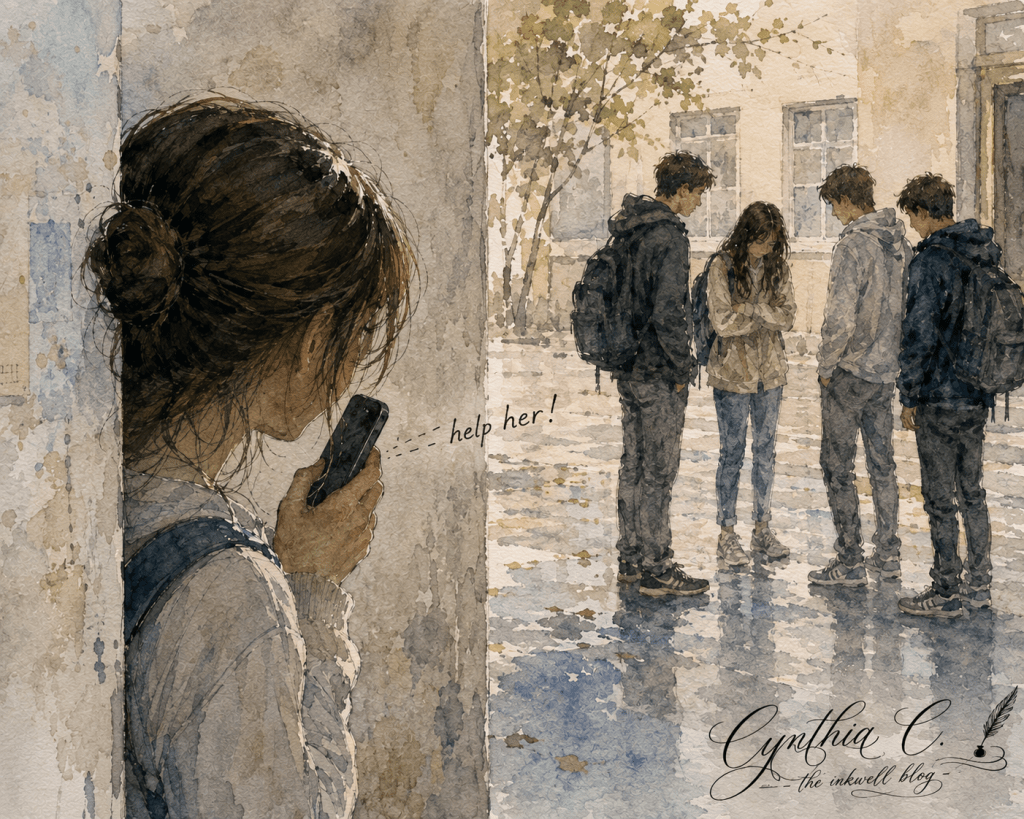
Sometimes the phone is also the witness
There is another uncomfortable possibility.
A mobile phone can sometimes be the only way a child can document what is happening to them.
An aggression in a corridor. Bullying somewhere. A threat. An assault. A situation in which the child knows that afterwards someone might simply ask:
“Are you sure that is what happened?”
This does not mean that students should be encouraged to film everything.
Recording people can create serious privacy and ethical problems, and filming an unfolding violent situation can put the person recording at greater risk.
But again, the answer should be education.
Teach students when they should seek immediate help. Teach them how to preserve evidence safely when appropriate. Teach them not to circulate images of victims. Teach them how to report an incident.
And, crucially, teach adults to take evidence seriously.
Sometimes, unfortunately, the phone may be the thing that allows the trusted adult to finally see what happened.
And then there is AI
This makes the issue even more urgent.
AI is not going away.
Young people are already using it. And it is part of daily work and study routines in developed counties of Easter Asia as it was the typewriter to Britain since Mill invented it in 1714 (and let’s remember how happy we all were when finally we could use computers to write and avoid that annoying editing that typewriters brought with them!).
A 2025 Pew Research Center survey found that 64% of U.S. teenagers aged 13–17 had used an AI chatbot. And what’s should raise questions that should be considered priority in all governments is that twelve percent said they had used chatbots for emotional support or advice.
We should take that seriously.
But we should interpret it correctly.
AI is not a substitute for psychologists, teachers, parents or friends. Current evidence does not support treating general-purpose chatbots as mental-health professionals for teenagers.
But if a teenager finds it easier to type a difficult question into a chatbot at midnight than to tell an adult at home, perhaps we should also ask:
Why was the chatbot easier to talk to?
Was it because the machine did not interrupt?
Because it did not visibly judge?
Because the teenager was afraid of disappointing a parent?
Because there was no psychologist available?
Because they simply did not know how to begin?
These are educational and social questions.
And they are ours.
Not children’s.
The adults have to build the bridge
Young people did not create the technological world they inherited.
They are growing up in it.
So our responsibility is not to pull them backwards whenever something becomes difficult. It is to give them the education, critical thinking and support they need to navigate it.
Teach them how technology works. Teach them how to recognise danger, manipulation and misinformation. Teach them when a phone belongs in a bag and when it may be essential.
Give them the tools — then teach them how to use them.
Because adults’ world is dangerous.
But it is also theirs.
And eventually, they will grow in these two, apparently distant, but much intertwined worlds.
A generation does not become safer because we remove its tools.
It becomes safer because we teach that generation how to use them, understand people, recognise danger, seek help and live with difference.
That is the responsibility of ADULTS.
And if we fail at that responsibility, taking away the phone will not save us.
🇫🇷 Quand nous bannissons le téléphone au lieu d’éduquer la personne
Il se passe quelque chose de de plus en plus étrange dans la façon dont de nombreuses sociétés parlent des jeunes et de la technologie. Un problème apparaît — distraction, cyberharcèlement, anxiété, troubles de l’alimentation, exposition à la violence — et la réponse politique consiste de plus en plus à retirer l’objet. Enlevez le téléphone. Bannissez-le à l’école. Mettez-le dans une pochette. Mettez-le dans un casier. Et peut-être que, pendant quelques heures, le problème devient lui aussi invisible. Mais rendre quelque chose invisible n’est pas la même chose que le résoudre. Je ne suis pas en train d’affirmer que les smartphones devraient être disponibles en permanence dans les salles de classe. Les écoles ont besoin de limites. Les enseignants doivent pouvoir enseigner sans que trente élèves ne vérifient simultanément leurs notifications. Mais je suis profondément mal à l’aise avec l’idée que restreindre l’accès des jeunes à la technologie équivaudrait d’une manière ou d’une autre à les éduquer à la technologie. Ce n’est pas le cas. LA CENSURE N’EST PAS DE L’ÉDUCATION. Le téléphone n’est pas le problème. La façon dont les sociétés éduquent les jeunes l’est.
Certains éléments prouvent que les restrictions peuvent réduire la distraction à l’école. L’OCDE a constaté que l’interdiction du téléphone peut favoriser la concentration en classe, bien que son efficacité dépende fortement de sa mise en œuvre. Surtout, les restrictions pendant les heures de cours ne créent pas nécessairement des habitudes numériques plus saines en dehors de l’école. D’autres recherches sont beaucoup moins concluantes. Une vaste étude australienne portant sur plus de 1 200 élèves du secondaire n’a révélé aucune différence significative à court terme entre les écoles avec et sans interdiction du téléphone concernant l’utilisation problématique du téléphone, l’engagement scolaire ou le sentiment d’appartenance à l’école. La France a également adopté une approche plus restrictive. Son dispositif « Portable en pause » a été étendu aux collèges publics à partir de l’année scolaire 2025-2026 suite à une expérimentation ayant impliqué plus de 32 000 élèves. Le ministère français de l’Éducation nationale fait état d’améliorations en matière de concentration, de climat scolaire et de bien-être. Ces résultats ne doivent pas être simplement rejetés. Mais ils ne doivent pas non plus être transformés en une affirmation bien plus large selon laquelle la prohibition aurait résolu le problème sous-jacent. Un élève qui apprend qu’il ne peut pas utiliser de téléphone entre 8h00 et 16h00 a appris une règle. Il n’a pas nécessairement appris comment les algorithmes manipulent l’attention, comment reconnaître la désinformation, comment réagir au cyberharcèlement, comment protéger la vie privée de quelqu’un, comment déceler la manipulation, comment utiliser l’IA de manière critique ou comment demander de l’aide. Ce sont des compétences. Et les compétences doivent être enseignées.
Nous faisons porter aux jeunes une responsabilité qui incombe aux adultes
C’est ici que la discussion devient plus inconfortable, je pense. De nombreuses sociétés font peser un poids de plus en plus lourd — presque une frontière — sur les épaules d’une génération qui a besoin de tout le contraire : d’aide, de soutien et de guidage. On attend des jeunes qu’ils gèrent leur éducation, leur comportement numérique, leur relation avec les réseaux sociaux, leur exposition à la désinformation et parfois même le bien-être de leurs pairs. Bien sûr que les jeunes ont des responsabilités. Mais l’éducation est la responsabilité des ADULTES. Cela signifie les institutions. Cela signifie les écoles, les gouvernements, les parents et les enseignants. Cela signifie aussi les universités et les professeurs. Être un adulte n’efface pas la différence entre être un étudiant adulte et être un éducateur adulte. Un étudiant de vingt ans et un professeur de quarante ans peuvent être tous deux des adultes, mais ils n’occupent pas la même position éducative et ne possèdent pas le même pouvoir institutionnel. L’éducation existe en partie pour reconnaître ces différences et les utiliser de manière responsable. Nous ne pouvons pas dire aux jeunes : « Vous êtes responsables de la compréhension de ce monde », tout en leur disant simultanément : « Vous n’êtes pas assez mûrs pour qu’on vous confie les outils à travers lesquels ce monde fonctionne. » C’est une contradiction qui mène inévitablement au chaos complet que l’on peut observer dans le monde entier concernant les jeunes générations, aujourd’hui clairement délaissées par les sociétés contemporaines et de nombreuses institutions.
Nous ne pouvons pas éduquer les gens pour un monde qui n’existe plus
Il y a une nostalgie étrange — presque irritante — qui apparaît dans les discussions sur la technologie. Un fantasme selon lequel nous pourrions simplement revenir au « bon vieux temps » : moins d’écrans, plus de livres, plus de conversations en face à face, des enfants qui jouent dehors. Il y a certainement des éléments des anciennes formes de vie sociale qui méritent d’être préservés. Mais ne romantisons pas le passé. Le harcèlement existait. La violence existait. L’exclusion sociale existait. Les troubles de l’alimentation existaient. Le suicide existait. La solitude existait. Internet n’a pas inventé la cruauté. Le smartphone n’a pas inventé l’insécurité. La technologie a surtout changé la visibilité de certaines de ces expériences. Cette distinction importe. Mais une autre évolution importe tout autant : LA PRISE DE CONSCIENCE. Nous avons désormais accès à une quantité extraordinaire d’informations sur la psychologie, la sociologie, la neurodiversité, la communication, les différences culturelles, les traumatismes et le comportement humain. Internet a rendu le savoir accessible à une échelle sans précédent. L’IA rend aujourd’hui une autre strate d’informations accessible par la conversation. Cela ne veut pas dire que tout ce qui se trouve en ligne est vrai. Cela signifie que nous avons une occasion sans précédent d’apprendre aux gens à déterminer ce qui est vrai. Nous ne devrions pas la gâcher.
Les dangers sont réels. L’explication est complexe et indispensable.
Nous ne devons pas minimiser les risques des environnements numériques. Les recherches de l’OMS/Europe menées dans 44 pays et régions ont révélé qu’environ un adolescent sur six avait été victime de cyberharcèlement, tandis que l’utilisation problématique des réseaux sociaux est passée de 7 % en 2018 à 11 % en 2022. Le Surgeon General des États-Unis a également mis en garde contre les risques potentiels pour la santé mentale associés aux réseaux sociaux, en particulier à des niveaux d’utilisation élevés. Mais cela ne fait pas d’Internet une explication suffisante pour les problèmes de santé mentale des adolescents. L’OMS décrit la santé mentale des adolescents comme le résultat de multiples facteurs en interaction, notamment les relations familiales, l’environnement scolaire, les pressions sociales, la violence, l’adversité et l’accès à un soutien approprié. Cela compte. Parce que lorsque quelque chose de tragique se produit, nous avons tendance à chercher un coupable unique. Le téléphone. La plateforme. L’adolescent. Parfois, il y a une défaillance identifiable. Mais de nombreuses situations sont considérablement plus compliquées. Un parent peut aimer son enfant et ne pas réussir à reconnaître une crise. Un enseignant peut se soucier profondément d’un élève tout en étant responsable de trente autres. Un ami peut savoir que quelque chose ne va pas sans comprendre à quel point c’est grave. Ce ne sont pas nécessairement des histoires de mauvaises personnes. Ce sont souvent des histoires de systèmes qui n’ont jamais été conçus pour gérer la complexité qu’on leur demande de gérer.
Ce dont nous avons réellement besoin, c’est de soutien
C’est pourquoi la conversation sur les téléphones devrait finalement mener ailleurs. Nous avons besoin d’une meilleure éducation psychologique. Nous avons besoin d’enseignants formés pour reconnaître les difficultés sociales et de santé mentale. Nous avons besoin que les parents aient un endroit où s’adresser lorsqu’ils ne comprennent pas ce qui arrive à leur enfant. Et nous avons besoin que les jeunes aient accès à des professionnels spécialisés sans avoir à se demander s’ils peuvent se le permettre ou s’ils doivent d’abord atteindre un point de crise. Parce que parfois, l’intervention la plus importante est étonnamment ordinaire : ÉCOUTER. Pas interroger. Pas minimiser. Pas corriger immédiatement. Écouter. Et puis, quand écouter ne suffit pas : GUIDER. Et quand guider ne suffit pas : OFFRIR UN ESPACE SÛR POUR GUÉRIR. Il ne s’agit pas de blâmer les familles. Les parents peuvent avoir peur eux aussi. La santé, la santé mentale et les difficultés psychologiques ne sont pas des sujets que toutes les familles savent aborder. Parfois, le problème commence au sein d’une famille. Parfois, il commence à l’école. Parfois ailleurs, totalement. C’est précisément pourquoi la responsabilité ne peut être entièrement rejetée sur un seul individu. Ou sur un appareil technologique. Nous avons besoin de systèmes capables de soutenir TOUS les individus.
Parfois, le téléphone est le dispositif de sécurité
Il y a une autre raison pour laquelle je ne soutiendrais jamais une interdiction totale des téléphones portables au sein des écoles. Nous devons être prêts à penser à des situations profondément déplaisantes à imaginer. Un incendie. Une attaque violente. Une urgence médicale. Une catastrophe naturelle. Un intrus dangereux. Ces situations sont rares mais RÉELLES. C’est précisément pour cela qu’elles sont impossibles à prédire. La fusillade de masse de 2022 à l’école élémentaire Robb d’Uvalde, au Texas, en est l’un des exemples les plus douloureux. Pendant l’attaque, des enfants piégés à l’intérieur de l’école ont utilisé leur téléphone pour appeler le 911 et contacter leurs familles. Le rapport officiel mentionne des élèves passant des appels d’urgence et communiquant avec leurs parents pendant le déroulement de l’incident. Et alors que le mois de novembre approche dans à peine deux mois, c’est aussi un élément dont il faut se souvenir alors que la France s’apprête à commémorer les victimes des attaques terroristes du 13 novembre 2015 à Paris, au Bataclan. Cette nuit-là est un rappel douloureux que les situations auxquelles nous avons le plus besoin de nous préparer sont souvent celles que nous ne pouvons pas prédire. Lors d’attaques, d’urgences lors de déplacements, ou même du 11 septembre, les téléphones sont devenus un moyen pour les personnes à l’intérieur de joindre leurs proches et les services d’urgence — un mince lien avec le monde extérieur quand tout le reste s’était effondré. Et rappelons-nous que les enfants ont besoin d’être éduqués à l’utilisation correcte de ces appareils, même dès le plus jeune âge, si l’on veut qu’ils n’en abusent pas, car c’est ainsi qu’on apprend la sécurité, et ils peuvent sauver des vies d’adultes, même à la maison et de façons inimaginables : En 2020, un garçon de cinq ans en Angleterre a sauvé sa mère en appelant le 112 après qu’elle est tombée inconsciente. Il avait reconnu le numéro sur le côté de son ambulance en jouet — une petite information qu’il avait absorbée en jouant, et qui est devenue cruciale lorsqu’il en a eu soudainement besoin. C’est ce que l’éducation peut faire : elle peut transformer un outil en une bouée de sauvetage. (Telford, Angleterre, juillet 2020 ; Police de West Mercia, 26 août 2020.)
Nous ne pouvons pas construire les politiques scolaires sur l’hypothèse que demain ressemblera toujours à hier. Une journée d’école ordinaire peut être réglementée. Une journée exceptionnelle ne peut pas être prédite. Et lorsque cette journée arrive, un téléphone peut être le seul lien d’un enfant avec le monde extérieur.
Parfois, le téléphone est aussi le témoin
Il existe une autre possibilité inconfortable. Un téléphone portable peut parfois être le seul moyen pour un enfant de documenter ce qui lui arrive. Une agression dans un couloir. Du harcèlement quelque part. Une menace. Une attaque. Une situation dans laquelle l’enfant sait qu’après coup, quelqu’un pourrait simplement demander : « Es-tu sûr que c’est ce qui s’est passé ? » Cela ne veut pas dire qu’il faut encourager les élèves à tout filmer. Filmer des gens peut créer de graves problèmes d’éthique et de vie privée, et filmer une situation violente en cours peut exposer la personne qui filme à un risque plus grand. Mais là encore, la réponse devrait être l’éducation. Apprendre aux élèves quand ils doivent chercher une aide immédiate. Leur apprendre à conserver des preuves en toute sécurité lorsque cela est approprié. Leur apprendre à ne pas faire circuler d’images de victimes. Leur apprendre à signaler un incident. Et, surtout, apprendre aux adultes à prendre les preuves au sérieux. Parfois, malheureusement, le téléphone est l’élément qui permet à l’adulte de confiance de voir enfin ce qui s’est passé.
Et puis il y a l’IA
Cela rend la question encore plus urgente. L’IA ne va pas disparaître. Les jeunes l’utilisent déjà. Et elle fait partie des routines quotidiennes de travail et d’étude dans les pays développés d’Asie de l’Est, tout comme la machine à écrire l’était pour la Grande-Bretagne depuis que Mill l’a inventée en 1714 (et rappelons-nous à quel point nous étions tous heureux quand nous avons enfin pu utiliser des ordinateurs pour écrire et éviter cette pénible réécriture que les machines à écrire imposaient avec elles !). Sondage Pew Research Center de 2025 : 64 % des adolescents américains âgés de 13 à 17 ans avaient utilisé un chatbot IA. Et ce qui devrait soulever des questions à considérer comme prioritaires pour tous les gouvernements, c’est que douze pour cent ont déclaré avoir utilisé des chatbots pour obtenir un soutien émotionnel ou des conseils. Nous devrions prendre cela au sérieux. Mais nous devrions l’interpréter correctement. L’IA ne remplace pas les psychologues, les enseignants, les parents ou les amis. Les données actuelles ne permettent pas de considérer les chatbots généraux comme des professionnels de la santé mentale pour adolescents. Mais si un adolescent trouve plus facile de taper une question difficile dans un chatbot à minuit que d’en parler à un adulte à la maison, peut-être devrions-nous aussi nous demander : Pourquoi le chatbot était-il plus facile à aborder ? Était-ce parce que la machine n’interrompait pas ? Parce qu’elle ne jugeait pas visiblement ? Parce que l’adolescent avait peur de décevoir un parent ? Parce qu’il n’y avait pas de psychologue disponible ? Parce qu’il ne savait tout simplement pas par où commencer ? Ce sont des questions éducatives et sociales. Et elles sont les nôtres. Pas celles des enfants.
C’est aux adultes de bâtir le pont
Les jeunes n’ont pas créé le monde technologique dont ils ont hérité. Ils grandissent dedans. Notre responsabilité n’est donc pas de les tirer en arrière dès que quelque chose devient difficile. Elle est de leur donner l’éducation, l’esprit critique et le soutien dont ils ont besoin pour y naviguer. Enseignez-leur le fonctionnement de la technologie. Enseignez-leur à reconnaître le danger, la manipulation et la désinformation. Enseignez-leur quand un téléphone doit être dans un sac et quand il peut être essentiel. Donnez-leur les outils — puis apprenez-leur à s’en servir. Parce que le monde des adultes est dangereux. Mais il est aussi le leur. Et à terme, ils grandiront dans ces deux mondes, en apparence distants, mais extrêmement entremêlés. Une génération ne devient pas plus en sécurité parce que nous lui retirons ses outils. Elle devient plus en sécurité parce que nous lui apprenons à les utiliser, à comprendre les autres, à reconnaître le danger, à demander de l’aide et à vivre avec la différence. C’est la responsabilité des ADULTES. Et si nous échouons à cette responsabilité, retirer le téléphone ne nous sauvera pas.
🇬🇧 When Inspiration Crosses the Line: Reflections on Intellectual Respect
There is something I want to clarify before anything else: this post is not intended to be judgmental but, I hope it can help to reflect on major unseen wounds the powerful ones can inflict on the less influential and known authors.. and possibly help to develop more intellectual (and human) honesty.
I know that influence often flows without intention. We absorb what we read, what we hear, what resonates with us. It’s normal.
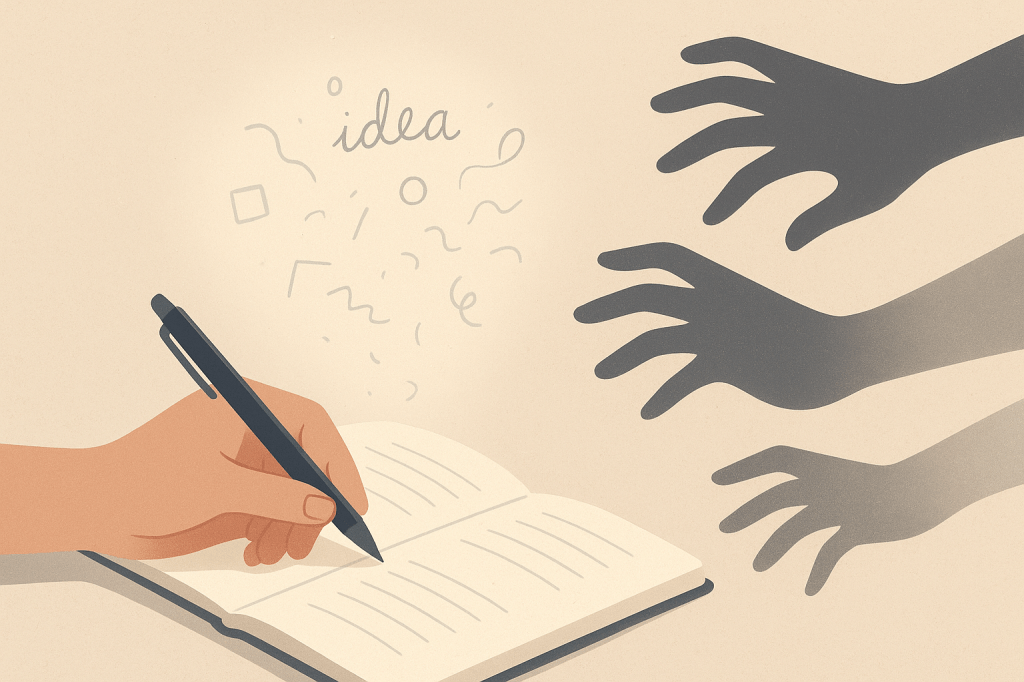
But sometimes that “inspiration” travels too far — to the point where someone’s work is lifted almost intact, placed into another context, and released as if it had no origin.
It’s very easy to do, especially when that source is a smaller voice, or when the idea comes from someone who isn’t a well-known author, unlike certain writers who — after a long writing life — sometimes seem to run out of novelty, and yet, still feel entitled to absorb from those less visible.
What strikes me in this era is the growing hunger for recognition, for fame especially on the web and mass media addictions that we couldn’t even imagine 10 years ago, as if visibility were the only shield that could protect one’s ideas from being quietly taken…
Perhaps that is why so many feel compelled to cling to the spotlight: because anything created outside of it becomes too easy to appropriate.
And truly, it would be enough to acknowledge the source.
In the last few months, I’ve noticed something curious — and unsettling.
Some of the reflections I’ve shared here, crafted with care and rooted in years of study, suddenly reappeared in articles, newsletters, and social commentaries written by people who have never exchanged a word with me although we have those famous 6 degrees of separation (my Italian teacher in high school was the daughter of the major Italian news director…and some who studied at my same school are now working in major tv shows and programmes…so…it’s not so difficult…). My phrases, my angles, my theories — repackaged as if they had always belonged to someone else.
It’s not dramatic. But it is revealing.
And it raises a bigger question: what does it mean to write, to create, when the lines between inspiration, borrowing, and exploitation have grown dangerously thin?
The Anthropologist’s Lens: Gifts, Theft, and the Circulation of Ideas
Anthropology has long studied how ideas move. Marcel Mauss described the “spirit of the gift”: even an object carries the imprint of the giver.
What we post online works the same way.
Even when words float freely, they carry a signature — an emotional, intellectual fingerprint.
The problem today is not that ideas circulate. It’s that platforms encourage strip-mining of thought without context, or acknowledgment.
Borrowing becomes extraction.
Inspiration becomes silent appropriation.
What once was dialogue now feels like content harvesting.
It is important to see what that inspiration has produced too: if someone less visible, a student for example, takes note during a lesson and develops reasonings based on what listens, it’s something (also because the professors are supposed to be trained, prepared to share only what they intend and useful for the lesson) – if a professor, a teacher, an established researcher uses what a student is beginning to develop…well, in my humble opinion, is something else…especially because that student is not prepared, not trained yet to protect themselves and their work from others’ greed.
This is something I’ve never been taught at University, and I have truly missed and felt I needed as a student coming from a family with no experience in university life: how to protect myself and my work from jackals.
Same with writers, or politicians: if a writer or politician doesn’t bother to pay a ghost writer as the good politicians of a generation ago used to do, it says already a lot of what you can expect from them…and I don’t like it…because there’s a echo of dishonesty and greed in such acts, that a civic society shouldn’t let happen.
Why it has to be so difficult to admit someone with less experience comes with a good idea? Why, instead of levelling down such brilliant minds, institutions and supervisors don’t acknowledge and guide in respectful ways said researcher?
Too many times I’ve seen and experienced how some feel entitled to appropriate others’ less famous or published authors-researchers, and kneecap them…because, yes, probably some of you don’t know how it feels, but I assure you when someone that is part (hence represents) an institution — being an university, a publishing company, or whatever— acts like that, they drain little by little that trust a young researcher has towards them, and society at large at times, and really you feel like they are shooting in your legs.
There is also Emotional Labour Behind —
Although people often underestimate the invisible labour behind writing.
Even a single post of a blog might be shaped by years of reading, fieldwork, lived experience, healing, or spiritual reflection. When someone takes the surface — a sentence, a point of view, an argument — they erase not just the source, but the process…and the person behind it.
Not mentioning physical pain when, as it’s happening recently to me, you start to experience chronic arthritis.
For many of us, especially those who write across culture, ethics, spirituality, and memory, the cost is double:
our voice is copied, but our vulnerability remains ours alone.
It’s not “just content”.
It’s intellectual labour — often unpaid and uncredited.
The Unpublished Work Problem
What unsettles me most is that this dynamic isn’t new.
It happened even when I was still studying, sharing early drafts, research ideas, or theoretical links during seminars, workshops, or private conversations.
That kind of intellectual production is almost impossible to protect: it isn’t published, it carries no official timestamp, and the fragility of student work makes it easy for others to absorb your insights and present them later as their own.
Those ideas existed — but only in spoken form, private notes, and early manuscripts that never received the “protection” of a publication date.
And so, when I see echoes of my academic reflections in later articles or research by others, I’m left with a familiar feeling: knowing something came from my mind, and in-field work, yet having no formal way to claim it back.
Sexism and Power Dynamics
This dynamic, unfortunately, often unfolds in profoundly gendered ways.
Women’s ideas, labour, and intellectual contributions are still too frequently absorbed, reframed, or claimed by more influential men who benefit from institutional positions, visibility, or authority – especially in patriarchal societies where this is just normalised as sexual harassment.
It is not always loud or explicit; often it is subtle, disguised as “mentorship,” “guidance,” or mere coincidence.
But beneath these narratives lies an old pattern: when power is unevenly distributed, the work of women becomes easier to appropriate, easier to silence, and harder to defend.
This is not only an issue of individual ethics — it reflects structural inequalities that allow certain voices to be amplified simply because they belong to men, while women must fight twice as hard to protect what they create.
Naming this imbalance is crucial, because respecting intellectual labour also means dismantling the gendered hierarchies that continue to shape who gets credit, who is paid (more), who is listened to, and who is quietly erased.
Some examples of how this habit is well rooted -throughout international contexts…
📚 Literature & Philosophy:
1. Zelda Fitzgerald (writer) — overshadowed by F. Scott Fitzgerald
Much of Zelda’s writing — diary passages, letters, even scenes she drafted — ended up incorporated into F. Scott Fitzgerald’s novels, most famously The Great Gatsby and Tender Is the Night. He often discouraged her from publishing independently, claiming it threatened his reputation.
2. Mary Wollstonecraft Shelley (writer) — initially credited to Percy Shelley
Early readers and critics believed Frankenstein had been written by Percy Shelley, not Mary. Percy edited the manuscript heavily and attached a preface in his own name, leading to decades of misattribution despite Mary being the true author.
3. Colette (novelist) — early novels published under her husband Willy’s name
Colette’s husband, Henry Gauthier-Villars (“Willy”), forced her to write the Claudine series while he published them under his own name. Only years later was she able to reclaim her authorship.
4. Simone de Beauvoir — overshadowed by Sartre’s fame
Although not “stolen,” her work was consistently diminished and subsumed under Sartre’s influence. Many of her philosophical contributions were attributed to him, despite her independent innovations.
🎼 Music & Composition:
5. Clara Schumann (composer & pianist) — overshadowed by Robert Schumann
Clara was a celebrated virtuoso and respected composer in her own right, but her works were often attributed to her husband or dismissed as secondary. Some of her compositions are now believed to have been published under Robert’s name.
6. Fanny Mendelssohn (composer) — published under Felix Mendelssohn’s name
Fanny wrote over 400 pieces, but her family discouraged her from publishing because she was a woman. Several of her songs were published under Felix’s name, with Felix later admitting she had superior musical talent.
7. Alma Mahler (composer) — silenced by Gustav Mahler
Gustav Mahler forbade Alma from composing after marriage, insisting there could not be “two composers in one family.” She wrote exceptional music early in life, much of it unpublished or suppressed.
🎨 Art & Academia:
8. Camille Claudel (sculptor) — overshadowed by Auguste Rodin
Claudel was Rodin’s collaborator and contributed heavily to some of his celebrated works. Her own artistic identity was overshadowed, and her contributions were often absorbed into Rodin’s legacy.
9. Lise Meitner (physicist) — discovery of nuclear fission credited to Otto Hahn
Although not a writer/composer, this is one of the clearest cases of intellectual appropriation: Meitner’s theoretical explanation of nuclear fission was essential, yet the Nobel Prize was given only to Hahn.
🖋 Publishing & Academia:
10. Rosalind Franklin (scientist) — DNA structure credited to Watson & Crick
Watson and Crick used Franklin’s photographs and data without permission or acknowledgment, building their model of DNA on her research. Her contribution was minimized for decades.
The Line Between Influence and Exploitation
Influence is natural. We all absorb and remix ideas.
Exploitation, however, has a different flavour. It often looks like:
No credit, even when the concept is nearly identical.
Rapid extraction: someone publishes your ideas days after you share them (and before you are allowed to expand said work).
Flattened context: your nuanced reflections appear in a superficial retelling.
Asymmetry of power: larger platforms take from smaller, careful voices, levelling down the main reasoning behind (because the priority is to publish sooner, faster and possibly more – to convince themselves -at least- of their superiority) .
This dynamic mirrors older patterns of cultural appropriation — the strong taking from the small, the loud taking from the reflective, the fast taking from the slow.
Five Small Things That (CAN) Make a Huge Difference
In reality, protecting intellectual work does not require monumental reforms.
It requires simply for small, although essential and civic gestures, that reflect honesty, integrity, and a basic respect for the labour of others.
Whether one is a supervisor, editor, publisher, or simply a reader, these actions matter:
Acknowledge your sources, even when they come from students, independent authors, or lesser-known voices. Prestige does not equal origin.
Cite ideas precisely, not vaguely; a clear reference is a form of intellectual fairness and prevents unintentional appropriation.
Maintain ethical boundaries in supervision and mentorship: support students’ growth without absorbing their insights into your own work.
Ask for permission when drawing on someone’s unpublished material — drafts, conversations, or seminar contributions are not “free”.
These may look like minor habits, but together they create a culture where thought is valued, not extracted.
Conclusion — On Trust, Institutions, and the Real Cost of Unacknowledged Work
Seeing others use your ideas without recognition is more than disappointing; it can erode motivation, confidence, and — perhaps most seriously — trust toward entire institutions.
When original contributions are overlooked or quietly absorbed into someone else’s research, students and independent authors learn a painful lesson: that VERY OFTEN visibility, not merit, determines whose ideas survive.
And this is dangerous.
It is essential that academic environments, publishers, and cultural institutions create clear methods for protecting student work and the creations of lesser-known authors. Because stealing from others does not make anyone grow. You might get away with it once, perhaps even twice — but the absence of the original mind behind those ideas eventually reveals itself. The reasoning, the method, the depth that were never yours cannot sustain you, and they cannot save an institution built on borrowed insight when they will need them original mind.
This is precisely where problems begin.
Respecting intellectual origins is not a courtesy; it is a safeguard.
It protects not only the author, but also the integrity of whoever engages with their ideas. When we acknowledge where thought comes from, we strengthen the entire structure of knowledge, and of a society itself.
Side Notes: Finding Strength to Write Again
I started to write again after a long period of silence and creative block, caused by seeing my work and ideas being silenced and later used by others. The turning point came thanks to a project I was awarded by two major Japanese institutions in an international selection. This recognition reminded me of my worth and confirmed that the work I had done was more than good enough.
As unfortunately that was a short-term project, I had to find within myself the strength and courage to continue, despite having no publishers or mentors actively supporting my writing at the time. Since then, I have managed to publish three articles — plus one more with an European University, though the journal is currently facing budget constraints due to global conflicts — simply because their value, both intellectual and human, was undeniable. I feel extremely proud and thankful, even if these should be the only works I ever see published in my life.
I continue to write and strive for visibility not for personal recognition, but for the work itself. I see too much mainstream discourse being treated as the “Holy Grail,” often with little to no reflection from researchers on the real impact of their own work on societies involved-considered. This is why I persist: to support ideas that are informed by welfare, women’s and children’s rights, and to ensure these principles remain central in every project.
The future is in today’s work : is shaped by what we choose to support, and grow now, for tomorrow.
This is why I cannot accept works that are based on losing progress and sight of human fundamental rights – regardless of their origins or beliefs.
I cannot ignore gender-based violence. I cannot, and will not, produce a major work that feels folkloristic or aestheticized if it entirely misses the lived realities of women and children — their basic needs, dignity, and rights.
My writing must always speak to these truths, grounding research, reflection, and publication in ethical responsibility.
If this means I will continue to have little support for my work, I will acknowledge it whilst continuing to feel proud and honest with others and respectful of humanity as of my own values.
____
🇫🇷 Quand l’inspiration dépasse la limite : réflexions sur le respect intellectuel
Il y a quelque chose que je souhaite clarifier avant toute chose : ce texte n’a aucune intention d’être moralisateur, mais j’espère qu’il pourra aider à réfléchir aux blessures invisibles que les plus puissants peuvent infliger aux auteurs moins connus ou moins influents… et peut-être encourager davantage d’honnêteté intellectuelle (et humaine).
Je sais que l’influence circule souvent sans intention. Nous absorbons ce que nous lisons, ce que nous entendons, ce qui résonne en nous. C’est normal .
Main parfois, cette « inspiration » va trop loin — au point que le travail de quelqu’un est repris presque tel quel, déplacé dans un autre contexte et publié comme s’il n’avait aucune origine.
C’est très facile à faire, surtout lorsque la source est une voix plus petite, ou lorsque l’idée vient de quelqu’un qui n’est pas un auteur célèbre — contrairement à certains écrivains qui, après une longue carrière, semblent parfois manquer de nouveauté mais se sentent tout de même légitimes d’absorber ce qui vient de ceux qui sont moins visibles.
Ce qui me frappe dans cette époque, c’est la faim croissante de reconnaissance, de célébrité, surtout avec l’addiction aux médias de masse et au web que nous n’aurions jamais pu imaginer il y a dix ans — comme si la visibilité était devenue le seul bouclier capable de protéger ses idées contre l’appropriation discrète…
Peut-être est-ce pour cela que tant de personnes s’accrochent désespérément à la lumière : parce que tout ce qui est créé en dehors d’elle devient trop facile à prendre.
Et, vraiment, il suffirait d’en reconnaître la source.
Ces derniers mois…
J’ai remarqué quelque chose de curieux — et d’inquiétant.
Certaines réflexions que j’ai publiées ici, pensées avec soin, enracinées dans des années d’étude, sont soudainement réapparues dans des articles, des newsletters ou des commentaires publics écrits par des personnes qui n’ont jamais échangé un mot avec moi, même si nous partageons ces fameux « six degrés de séparation » (ma professeure d’italien au lycée était la fille d’un des plus grands directeurs de presse italiens… et certains anciens élèves de mon école travaillent aujourd’hui dans de grandes émissions télévisées… donc ce n’est pas si improbable).
Mes phrases, mes angles, mes raisonnements — réemballés comme s’ils avaient toujours appartenu à quelqu’un d’autre.
Ce n’est pas dramatique.
Mais c’est révélateur.
Et cela pose une question plus vaste :
que signifie écrire, créer, quand les frontières entre inspiration, emprunt et exploitation deviennent dangereusement floues ?
Le regard de l’anthropologue : dons, vols et circulation des idées
L’anthropologie étudie depuis longtemps la manière dont les idées circulent.
Marcel Mauss parlait de « l’esprit du don » : même un objet porte l’empreinte de celui qui l’a offert.
Ce que nous publions en ligne fonctionne de la même manière.
Même lorsque les mots flottent librement, ils gardent une signature — une empreinte émotionnelle et intellectuelle.
Le problème aujourd’hui n’est pas que les idées circulent :
c’est que les plateformes encouragent l’extraction de pensée sans contexte, sans attribution.
L’emprunt devient extraction.
L’inspiration devient appropriation silencieuse.
Ce qui était dialogue devient récolte de contenu.
Il est important aussi de voir ce que cette « inspiration » produit réellement : si une personne moins visible, par exemple un étudiant, prend des notes pendant un cours et développe des raisonnements à partir de ce qu’il entend, c’est une chose (d’autant plus que les professeurs sont censés être formés et partager uniquement ce qu’ils souhaitent transmettre).
Mais si un professeur, un enseignant, un chercheur établi utilise ce qu’un étudiant commence à développer… alors, à mon humble avis, c’est tout autre chose — surtout parce que cet étudiant n’est pas encore préparé ni formé pour se protéger de la convoitise d’autrui.
C’est quelque chose qu’on ne m’a jamais appris à l’Université, et cela m’a énormément manqué : comment me protéger, moi et mon travail, des chacals.
Même chose pour les écrivains ou les hommes politiques : si un auteur ou un politicien ne se donne même pas la peine de rémunérer un nègre littéraire, comme le faisaient les bonnes figures politiques d’autrefois, cela en dit déjà long… Il y a dans ces gestes un écho de malhonnêteté et de cupidité qu’une société civique ne devrait pas tolérer.
Pourquoi est-il si difficile d’admettre qu’une personne moins expérimentée peut avoir une bonne idée ?
Pourquoi, au lieu de rabaisser ces esprits brillants, les institutions et les superviseurs n’admettent-ils pas, n’accompagnent-ils pas, ne guident-ils pas avec respect ces chercheurs ?
J’ai trop souvent vu — et vécu — comment certains se sentent autorisés à s’approprier le travail d’auteurs moins connus ou moins publiés, et à les saboter…
Et je vous assure que lorsque quelqu’un représentant une institution — université, maison d’édition ou autre — agit ainsi, il draine peu à peu la confiance qu’un jeune chercheur place en lui… et parfois en la société tout entière.
On a vraiment l’impression qu’ils vous tirent dans les jambes.
Il y a aussi le travail émotionnel derrière l’écriture…
On sous-estime souvent le travail invisible derrière l’écriture.
Même un simple billet de blog peut être façonné par des années de lectures, de terrain, d’expérience vécue, de guérison, ou de réflexion spirituelle.
Quand quelqu’un prend la surface — une phrase, un point de vue, un argument — il efface non seulement la source, mais aussi le processus… et la personne derrière.
Sans parler de la douleur physique lorsque, comme cela m’arrive récemment, on commence à ressentir une arthrite chronique.
Pour beaucoup d’entre nous, surtout celles et ceux qui écrivent entre culture, éthique, spiritualité et mémoire, le coût est double :
notre voix est copiée, mais notre vulnérabilité reste nôtre.
Ce n’est pas « juste du contenu ».
C’est du travail intellectuel — souvent non payé, non crédité.
Le problème du travail non publié
Ce qui me trouble le plus, c’est que cette dynamique n’a rien de nouveau.
Elle existait déjà lorsque j’étais étudiante : brouillons, idées de recherche, liens théoriques partagés pendant des séminaires, ateliers ou conversations privées.
Cette production intellectuelle est presque impossible à protéger : elle n’est pas publiée, n’a pas de date officielle, et la fragilité du travail étudiant le rend trop facile à absorber et à revendiquer plus tard.
Ces idées existaient — mais seulement sous forme orale, de notes privées ou de manuscrits précoces… sans protection éditoriale.
Donc, quand je retrouve l’écho de mes réflexions académiques dans des articles ou recherches ultérieurs, je ressens un sentiment familier : savoir que quelque chose vient de mon esprit, de mon terrain, sans avoir aucun moyen de le revendiquer.
Sexisme et dynamiques de pouvoir
Cette dynamique se manifeste, malheureusement, dans des formes profondément genrées.
Les idées, le travail et les contributions intellectuelles des femmes sont encore trop souvent absorbés, reframés ou revendiqués par des hommes plus influents bénéficiant de positions institutionnelles, de visibilité ou d’autorité — surtout dans des sociétés patriarcales où ce comportement est normalisé comme forme de harcèlement.
Ce n’est pas toujours flagrant ; c’est souvent subtil, déguisé en « mentorat », « guidage », ou simple « coïncidence ».
Mais derrière ces récits se cache un vieux schéma : lorsque le pouvoir est inégalement distribué, le travail des femmes devient plus facile à prendre, à réduire au silence, à effacer.
Cela reflète des inégalités structurelles :
qui a le droit d’être entendu ?
qui est payé (davantage) ?
qui est reconnu ?
et qui est discrètement effacé ?
Reconnaître ce déséquilibre est essentiel, car respecter le travail intellectuel signifie aussi démanteler les hiérarchies de genre qui déterminent encore aujourd’hui à qui appartient la pensée.
Exemples connus de cette habitude solidement enracinée…
📚 Littérature & philosophie:
Zelda Fitzgerald — absorbée par F. Scott Fitzgerald
Mary Shelley — souvent attribuée à Percy Shelley
Colette — publiée au nom de son mari Willy
Simone de Beauvoir — constamment minimisée au profit de Sartre
🎼 Musique & composition:
Clara Schumann — éclipsée par Robert Schumann
Fanny Mendelssohn — publiée sous le nom de Felix
Alma Mahler — interdite de composer par Gustav
🎨 Art, sciences & académies:
Camille Claudel — contributions absorbées par Rodin
Lise Meitner — éclipsée par Otto Hahn
Rosalind Franklin — bases de l’ADN utilisées sans autorisation
La ligne entre influence et exploitation
L’influence est naturelle.
L’exploitation a un tout autre goût.
Elle ressemble souvent à :
aucune citation alors que le concept est quasi identique ;
extraction rapide : quelqu’un publie vos idées avant que vous puissiez les développer ;
aplatissement : vos nuances disparaissent ;
asymétrie de pouvoir : les grandes plateformes prennent aux voix plus petites.
Cela reflète des schémas anciens d’appropriation culturelle :
le fort prenant au petit, le bruyant prenant au réfléchi, le rapide prenant au patient.
Cinq petites choses qui (peuvent) changer beaucoup
Reconnaître vos sources, même lorsqu’elles viennent d’étudiants ou d’auteurs indépendants.
Citer précisément, pas vaguement.
Maintenir des limites éthiques dans l’encadrement académique.
Demander la permission avant d’utiliser du matériel non publié.
Encourager la transparence éditoriale : brouillons datés, accords clairs.
Ces gestes créent une culture où la pensée est respectée, pas extraite.
Conclusion — Sur la confiance, les institutions et le coût réel du travail non reconnu
Voir ses idées utilisées sans reconnaissance n’est pas seulement décevant ; cela peut éroder la motivation, la confiance et — plus grave encore — la foi envers les institutions.
Trop souvent, jeune chercheur ou auteur indépendant apprend que la visibilité, et non le mérite, détermine la survie d’une idée.
Et c’est dangereux.
Les institutions doivent mettre en place des moyens clairs pour protéger le travail étudiant et celui des auteurs moins connus.
Voler les idées d’autrui ne fait grandir personne.
On peut le faire une fois, deux fois… mais l’absence de la pensée originale finit toujours par se voir.
Les raisonnements qui ne vous appartiennent pas ne vous soutiendront pas lorsque vous en aurez besoin.
Notes personnelles : retrouver la force d’écrire
J’ai recommencé à écrire après une longue période de silence, causée par la douleur de voir mes idées être tues puis utilisées par d’autres.
Le tournant est venu grâce à un projet attribué par deux grandes institutions japonaises lors d’une sélection internationale.
Cette reconnaissance m’a rappelé ma valeur.
Mais ce projet était court. Alors j’ai dû trouver en moi le courage de continuer, sans éditeur, sans superviseur pour me soutenir.
Depuis, j’ai publié trois articles — et un quatrième en attente, malgré des difficultés budgétaires liées aux conflits actuels.
Je continue à écrire non pour être vue, mais pour que le travail lui-même soit visible.
Je refuse les discours superficiels, folklorisants, détachés des réalités des femmes et des enfants.
Je ne peux ignorer les violences de genre.
Je ne peux produire un travail qui trahit la dignité humaine.
Si cela signifie recevoir peu de soutien, j’en prends acte.
Je préfère rester fidèle à mes valeurs, à l’éthique, et au respect de l’humanité.




You must be logged in to post a comment.