🇬🇧This meeting should (and could) have been an email (short version)
How to save money and accidentally make the green transition happen in the right way — and with no extra costs
We have been talking about the “green transition” for years now.
And if you look at the amount of money being mobilised, it would be difficult to argue that governments have simply ignored it.
The European Union’s 2021–2027 long-term budget and NextGenerationEU together amount to around €2 trillion. The EU originally committed to directing at least 30% of this envelope towards climate objectives; current Commission projections put the climate contribution at around €662 billion, or 34% of the total. (European Commission)
The Recovery and Resilience Facility alone has a climate target of 37%, and by 2025 Member States had committed more than €275 billion — over 42% of the total estimated RRF costs — to climate objectives. (European Commission)
So yes: there is European money.
But there is an important distinction.
There is not one enormous European pot of money that simply pays for the green transition everywhere.
EU funding is combined with national public budgets, national co-financing, loans, private investment and other financial instruments. The European Commission itself describes the EU budget as one part of a much larger investment effort. And the Recovery and Resilience Facility is temporary: it is due to end in 2026. (European Commission)
Meanwhile, the scale of what Europe still needs is enormous.
Recent ECB analysis estimates that Europe will need to mobilise an additional 2.7–3.7% of EU GDP every year until 2030 to achieve the green transition. Another ECB analysis estimates an average public green-funding gap of around €20 billion per year between 2025 and 2030, even after taking available EU funds into account. (European Central Bank)
And this is where things become interesting.
Because we have spent years telling a very simple story about the green transition:
Governments need to invest more. Far bad countries are making this impossible to happen.
But perhaps this is only part of the story.
For instance China’s clean-energy investment exceeded $625 billion in 2024, almost doubling since 2015. It also achieved its 2030 target for wind and solar capacity six years ahead of schedule. (IEA)
The IEA estimates that China continues to account for nearly 60% of global renewable-capacity growth, while solar PV has become the single largest area of global energy investment. Global solar investment alone was expected to reach around $450 billion in 2025. (IEA)
So the comfortable idea that the green transition is simply a matter of some countries being “serious” and others being “bad” is becoming increasingly difficult to defend.
The reality is much more complicated.
Countries are investing enormous amounts.
But…
But….Some are moving faster than others.
And above, all….Some have BETTER policies than others.
Some have developed impressive financial mechanisms but still perform poorly on other indicators.
And even Europe, despite its considerable investment, has many a country that fail on a daily basis in simple actions that would cost zero extra funds and would reduce enourmously amounts of public money – but also of private citizens.
This means that something else needs to change — and it needs to change now.
Because perhaps the green transition should not only be a question of:
How much more money can governments put into it?
Perhaps we should also ask:
How much waste can governments eliminate without spending more?
In my subscribers post you will find 10 crucial points of our societies that could be improved with 0 extra costs.
It is a reasoning that comes from evidence I have gathered while working and living in different countries and continents.
It is a story of digitalization, of naming things for what they are — crisis and prevention, for instance — and of bringing responsibility to the right side: the side of institutions and those that should educate and inform citizens.
Because sometimes the problem is not that we lack a green solution…or funds.
Sometimes the problem is that we are still organising our societies in ways that were wrong à century ago and continue to worsen whilst making the solution unnecessarily difficult, expensive and wasteful.
And perhaps this is where a different kind of green transition should begin.
There is much more coming in these subscription versions of my posts, and it is a much more sustainable way to read and “get inspired” by my writings (instead of taking here and there and fuel your debate not even quoting me!)
💁🏻♀️
🇫🇷Cette réunion aurait dû (et aurait pu) être un e-mail (version courte).
Comment économiser de l’argent et faire advenir accidentellement la transition verte de la bonne manière — et sans frais supplémentaires
On parle de la « transition verte » depuis des années maintenant.
Et si l’on regarde le montant des sommes mobilisées, il serait difficile de prétendre que les gouvernements l’ont simplement ignorée.
Le budget à long terme 2021–2027 de l’Union européenne et NextGenerationEU s’élèvent ensemble à environ 2 000 milliards d’euros. L’UE s’était initialement engagée à consacrer au moins 30 % de cette enveloppe à des objectifs climatiques ; les projections actuelles de la Commission situent la contribution climatique à environ 662 milliards d’euros, soit 34 % du total. (Commission européenne)
La Facilité pour la reprise et la résilience comporte à elle seule un objectif climatique de 37 %, et d’ici 2025, les États membres avaient engagé plus de 275 milliards d’euros — soit plus de 42 % des coûts totaux estimés de la FRR — pour des objectifs climatiques. (Commission européenne)
Alors oui : il y a de l’argent européen.
Mais il y a une distinction importante.
Il n’existe pas un énorme pot de vin financier européen unique qui paie simplement la transition verte partout.
Les financements de l’UE sont combinés avec les budgets publics nationaux, le cofinancement national, les prêts, les investissements privés et d’autres instruments financiers. La Commission européenne elle-même décrit le budget de l’UE comme une partie d’un effort d’investissement beaucoup plus vaste. Et la Facilité pour la reprise et la résilience est temporaire : elle doit prendre fin en 2026. (Commission européenne)
Pendant ce temps, l’ampleur de ce dont l’Europe a encore besoin est énorme.
Une analyse récente de la BCE estime que l’Europe devra mobiliser chaque année entre 2,7 % et 3,7 % de PIB européen supplémentaire jusqu’en 2030 pour réaliser la transition verte. Une autre analyse de la BCE estime un déficit moyen de financement vert public d’environ 20 milliards d’euros par an entre 2025 et 2030, même après avoir pris en compte les fonds européens disponibles. (Banque centrale européenne)
Et c’est là que les choses deviennent intéressantes.
Parce que nous avons passé des années à raconter une histoire très simple sur la transition verte :
Les gouvernements doivent investir davantage. De grands méchants pays rendent la chose impossible à réaliser.
Mais c’est peut-être seulement une partie de l’histoire.
Par exemple, les investissements de la Chine dans les énergies propres ont dépassé 625 milliards de dollars en 2024, doublant presque depuis 2015. Elle a également atteint son objectif de capacité éolienne et solaire pour 2030 avec six ans d’avance sur le calendrier. (AIE)
L’AIE estime que la Chine continue d’assurer près de 60 % de la croissance mondiale de la capacité renouvelable, tandis que le solaire photovoltaïque est devenu le premier poste d’investissement énergétique mondial. L’investissement mondial dans le seul domaine solaire devait atteindre environ 450 milliards de dollars en 2025. (AIE)
Ainsi, l’idée confortable selon laquelle la transition verte est simplement une question de pays « sérieux » et d’autres qui seraient « méchants » devient de plus en plus difficile à défendre.
La réalité est beaucoup plus complexe.
Les pays investissent des montants gigantesques.
Mais…
Mais…. Certains avancent plus vite que d’autres.
Et surtout…. Certains ont de MEILLEURES politiques que d’autres.
Certains ont développé des mécanismes financiers impressionnants mais enregistrent encore de de mauvais résultats sur d’autres indicateurs.
Et même l’Europe, malgré ses investissements considérables, compte de nombreux pays qui échouent au quotidien dans des actions simples qui ne coûteraient aucun fonds supplémentaire et réduiraient énormément les montants d’argent public — mais aussi ceux des citoyens privés.
Cela signifie que quelque chose d’autre doit changer — et doit changer maintenant.
Parce que la transition verte ne devrait peut-être pas être seulement une question de :
Combien d’argent en plus les gouvernements peuvent-ils y injecter ?
Nous devrions peut-être aussi demander :
Combien de gaspillage les gouvernements peuvent-ils éliminer sans dépenser plus ?
Dans mon article réservé aux abonnés, vous trouverez 10 points cruciaux de nos sociétés qui pourraient être améliorés avec 0 coût supplémentaire.
C’est un raisonnement issu des preuves que j’ai rassemblées en travaillant et en vivant dans différents pays et continents.
C’est une histoire de digitalisation, de nommer les choses pour ce qu’elles sont — crise et prévention, par exemple — et d’apporter de la responsabilité du bon côté : le côté des institutions et de ceux qui devraient éduquer et informer les citoyens.
Parce que parfois, le problème n’est pas que nous manquions d’une solution verte… ou de fonds.
Parfois, le problème est que nous organisons encore nos sociétés de manières qui étaient fausses il y a un siècle et continuent de s’aggraver tout en rendant la solution inutilement difficile, coûteuse et gâchée.
Et c’est peut-être là qu’un autre type de transition verte devrait commencer.
Il y aura beaucoup d’autres choses à venir dans ces versions sous abonnement de mes articles, et c’est une façon bien plus durable de lire et de « s’inspirer » de mes écrits (au lieu de prendre ici et là et d’alimenter votre débat sans même me citer !)
In recent years, ikigai has become a widely shared term across Western media, often simplified into diagrams or productivity formulas. While this circulation reflects -at times- a genuine curiosity toward Japanese philosophy, it also risks flattening a concept that is, in reality, deeply cultural, nuanced, and lived rather than “applied.”
I have developed my professional skills and expertise while working across Japan, France, the United Kingdom, and Italy, so I have seen this happening very often: Concepts do not travel unchanged. They are interpreted, reorganised, and sometimes reshaped to fit different intellectual traditions andsocial expectations.
What begins as a lived philosophy can easily become a model.
What is fluid becomes structured.
What is personal experience becomes a universal truth.
For this reason, approaching ikigai requires a certain attention—not only to its meaning, but to the context from which it emerges.
Ikigai as often happens abroad with Japanese words, has been used as topic to boost some sort of empty rhetoric about Japan or to show off some self proclaimed expertise without having taken a single course in Eastern Asia studies of any sorts.
Ikigai (生き甲斐) indeed, is not simply a word or a diagram—it is a philosophical orientation toward life.
Let’s give a closer look at what Ikigai (生き甲斐) Actually Refers To
Composed by the kanji 生き甲斐 we can identity first two main elements in it:
生き (iki) → living, being alive, to live
甲斐 (gai) → value, effect, result, worth, where 斐 alone means beautiful, and all together gives the sense of that which makes something worth.
A translation would therefore be:
“What gives value to life” with a sense of living value of things in one’s own life.
Hence nothing directly referring to success. Nor career or productivity. Rather something that one can find in small little things of everyday life.
Vey different from the diagram and set of values generally attached to this concept, don’t you think?
In Japan, it is generally referred to as meaning, in its purest, and most intimate, everyday form.
Rather than a set of instructions, it points toward a sense of meaning that emerges through living; Not something abstract, and not something to be found through some very difficult calculations.
It is embedded in daily life, in self awareness, and in small continuities.
Between Interpretation and Reduction
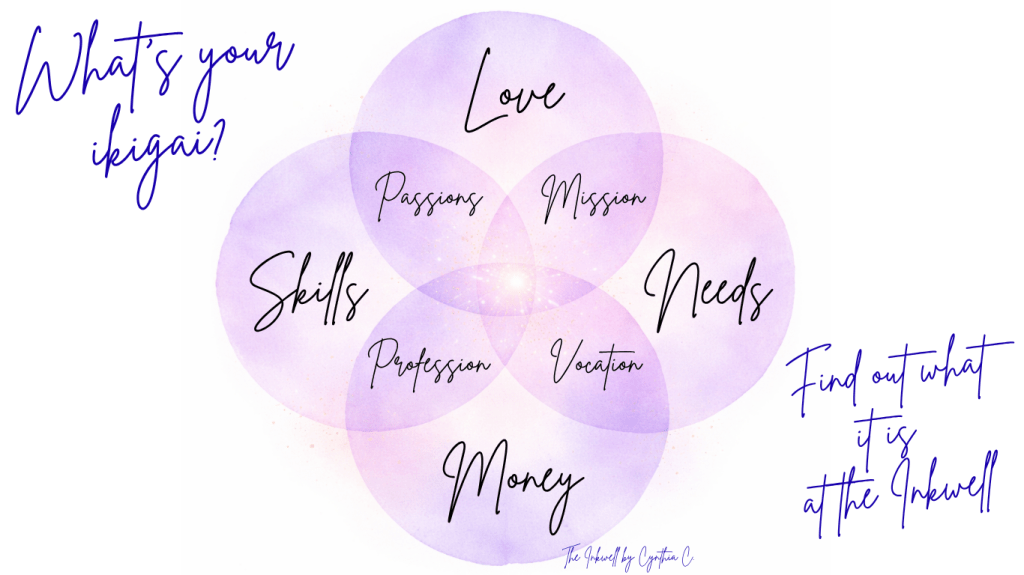
One of the most widespread reinterpretations of ikigai is the 4-circle Venn diagram, or four-circle diagram, that should be used to identify what one likes doing, has expertises in, what they think the world and society need, and what they could be paid for, and consequently combining all this answers, be able to indicate the one ideal life activity/job.
The questions to answer on each of these four parts are :
what do you like?
what are you good at?
what does the world need?
what can you be paid for?
This structure is effective, which explains its success.
It offers clarity, direction, and a sense of control.
However, it is important to acknowledge that:
this model does not originate from Japanese tradition.
It is a reconstruction—one that reflects a particular cultural tendency to organise meaning into systems.
On the Origins of the “Ikigai Diagram”
As already mentioned, the diagram most commonly associated with ikigai today—the four intersecting circles—does not originate from Japan.
Its structure can be traced back to a model developed by Spanish author Andrés Zuzunaga, who, in the early 2010s, created a visual framework exploring the idea of purpose through the intersection of the 4 famous:
what you love
what you are good at
what the world needs
what you can be paid for
This model circulated independently before later being associated with the term ikigai, particularly through Western self-development literature and coaching practices.
Over time, the two became merged.
Books such as Ikigai: The Japanese Secret to a Long and Happy Life contributed significantly to the global popularisation of the term, though the diagram itself reflects more a Western framework of purpose and career alignment than a traditional Japanese conceptualisation.
Why This Matters?
This is not to dismiss the usefulness of the diagram, on the contrary, it can function as a valuable reflective tool for people from cultures where such conceptualisations are fundamental.
However, understanding its origin allows us to see it for what it is:
not a representation of ikigai itself,
but an interpretation—shaped by different cultural expectations and understandings.
Furthermore, this same diagram introduces to this concept:
structure
a sort of profiling approach,
and often, an implicit link to productivity and economic expections.
The Japanese Origins
A more recent western understanding of ikigai has been developed from Japan, and most notably was discussed by Japanese psychiatrist Mieko Kamiya in her 1966 work, but it only entered widespread Western discourse much later.
As mentioned, one of the first major global bestsellers to introduce the term to a broad international audience was Ikigai: The Japanese Secret to a Long and Happy Life, a self-development book by Héctor García and Francesc Miralles, published in English in 2016–2017. This book, inspired by observations in Okinawa, played a decisive role in transforming ikigai into a widely recognised concept within self-development literature, contributing to its interpretation as a form of purpose linked to daily habits, longevity, and personal fulfilment.
Its international success—selling millions of copies and being translated into numerous languages—helped establish ikigai as part of a broader trend of importing Asian lifestyle philosophies into other cultural frameworks (alongside other concepts such as zen or wabisabi, but also yoga related elements that hugely have permeated European societies since late 19th and early 20th centuries).
Ikigai, in its original context, remains:
informal
non-visual
detached from professional identity
In Japan, ikigai can be:
quiet
partial
evolving
contradictory
And importantly, it does not need to be justified through productivity or economic value.
Language, Culture, and Misinterpretation
As you can easily observe even at the supermarket, when concepts travel between cultures—especially those rooted in lived practices—they often become reframed through external expectations.
This Venn model diagram can be useful, and as we saw, it is a modern reinterpretation, inspired by—but not completely equivalent to—ikigai.
Think of ikigai as something that can be:
small (a morning ritual, a craft, a relationship)
evolving (changing across life stages)
quiet (not necessarily visible or “productive”)
This distinction matters, especially in a global context where meaning is often tied to performance.
“Ikigai as an Inner Dialogue”
Not by imposing structure from the outside, but by allowing an internal dialogue to take place.
A dialogue that is often postponed.
At its core, ikigai is not something you “find” once.
It is something you continuously negotiate within yourself.
An Inner Conversation We Rarely Allow
At the centre of ikigai is a form of questioning that is deceptively simple.
It begins with a simple, yet often neglected act:
Allowing oneself to ask honest questions.
This inner dialogue moves between two dimensions:
1. The Personal Sphere
Your intimate, individual world:
What do I naturally enjoy?
What brings me calm or energy?
What do I return to, even without reward?
What did I love before I felt observed or evaluated, or even undervalued?
This dimension is not always stable.
It shifts, it withdraws, it reappears.
This is the space of authenticity, often silenced by external pressure.
2. The Social Sphere
A space that situates the individual among others:
Where can I be useful?What is needed in the environments I am part of?
What skills can I offer without self-betrayal?What can I offer without feeling diminished?
How can I contribute without exhaustion or resentment?
What feels aligned, rather than imposed?
This is not about sacrifice—but about sustainable participation in society.
“It is more a sustainable process, like constructing a path”
In Japan, as elsewhere, uncertainty exists.
People lose direction, question their place, hesitate between possibilities.
Ikigai does not resolve this uncertainty.
It offers something else:
a way to construct a path so to allow everyone to explore oneself through questions, although none of the answers may appear clearly defined.
Ikigai indeed, emerges not from perfection, but from balance. It is the subtle convergence where:
personal happiness does not exclude responsibility
contribution does not erase individuality
As already saw, in Western adaptations, this is often mapped into four guiding questions:
What do I love? (passion)
What am I good at? (vocation / skills)
What does the world need? (mission)
What can I be paid for? (profession)
But rather than fixed categories, think of these as overlapping, sometimes in tension.
Hence, to summarise, in Japanese contexts, ikigai:
does not require monetisation
does not require ambition
does not require visibility
A person’s ikigai might be:
tending a garden
caring for family
practicing a craft
maintaining a daily ritual
baking
Gentle Practices
Rather than solving ikigai as a puzzle, it can be approached as a practice of attention.
You might begin with:
noticing what gives you energy (not just pleasure)
observing what feels meaningful after it is done
identifying what drains you—even if socially valued
Over time, patterns emerge.
And within those patterns, a path forms—not imposed, but recognised.
This is not a question of adaptation or sacrifice,
but of finding a position that remains livable over time.
Difficult times are not new.
Every society, in every era, has faced uncertainty, imbalance, and transformation.
What changes is how we respond.
“Points of Tension, Not Boxes to Fill”
What do I love?
What am I capable of?
What is needed?
What can sustain me?
We have read often these questions in this post, and I hope you can now think of them rather than as fixed categories, as:
points of tension that require ongoing adjustment
They do not necessarily align.
And they are not meant to.
Ikigai does not appear as a perfect intersection as you can see now.
It takes shape within the space where different conditions, or even contradictions, become manageable.
“Rethinking Value”
One of the most significant shifts, when returning closer to the Japanese understanding, is this:
Ikigai does not need to be visible.
It does not need to be productive.
It does not need to be monetised.
It may exist in:
Small everyday life repetition (ie. having tea…)
care (ie. gardening…)
maintenance (ie. Tidying up…)
attention to detail (ie. Cooking…)
continuity over time (ie. Finding time to send a message to a dear one, or to call, or write a letter…)
Recognising this allows for a different relationship to value—one that is not entirely dependent on external validation, but comes from our inner wellbeing and adjusts in accordance with it, whilst staying in balance with the world outside us.
Conclusions
Periods of difficulty, uncertainty, and imbalance are not anomalies.
They are recurring conditions across time and societies.
What changes is the way individuals relate to themselves within those conditions.
Returning to concepts such as ikigai is not about adopting a model,
but about reopening a space of reflection that is often neglected.
Not to find definitive answers,
but to allow a more attentive relationship to one’s own trajectory whilst keeping respect for the worlds beyond ourselves.
And perhaps, especially in more difficult moments, to begin again from something essential:
to learn to love oneself—so as to become more compassionate and more helpful towards others.
Not necessarily by being visible,
not necessarily by being present in a conventional sense,
but by contributing—sometimes quietly, sometimes from a distance—
in ways that remain aligned with both oneself and the world one is part of.
——
🇫🇷 IKIGAI(生き甲斐)— Un concept, pas une tendance
Ces dernières années, ikigai est devenu un terme largement diffusé dans les médias occidentaux, souvent simplifié en diagrammes ou en formules de productivité. Si cette circulation reflète — parfois — une véritable curiosité pour la philosophie japonaise, elle risque également d’aplatir un concept qui est, en réalité, profondément culturel, nuancé et vécu, plutôt que « appliqué ».
J’ai développé mes compétences et mon expertise professionnelles en travaillant entre le Japon, la France, le Royaume-Uni et l’Italie, et j’ai donc observé ce phénomène à de nombreuses reprises : les concepts ne voyagent pas inchangés. Ils sont interprétés, réorganisés, et parfois remodelés pour s’adapter à différentes traditions intellectuelles et attentes sociales.
Ce qui commence comme une philosophie vécue peut facilement devenir un modèle.
Ce qui est fluide devient structuré.
Ce qui relève de l’expérience personnelle devient une vérité universelle.
Pour cette raison, aborder l’ikigai demande une certaine attention — non seulement à son sens, mais aussi au contexte dont il émerge.
L’ikigai, comme cela arrive souvent à l’étranger avec les mots japonais, a parfois été utilisé comme prétexte pour alimenter une rhétorique creuse sur le Japon, ou pour afficher une expertise autoproclamée sans avoir suivi la moindre formation en études d’Asie orientale.
L’ikigai (生き甲斐), en réalité, n’est pas simplement un mot ou un diagramme — c’est une orientation philosophique vers la vie.
Regardons de plus près ce à quoi renvoie réellement l’ikigai (生き甲斐)
Composé des kanji 生き甲斐, on peut en identifier deux éléments principaux :
生き (iki) → vivre, être en vie 甲斐 (gai) → valeur, effet, résultat, mérite (où 斐 seul signifie « beau »), l’ensemble suggérant ce qui donne de la valeur à quelque chose
Une traduction possible serait donc :
« Ce qui donne de la valeur à la vie », avec l’idée d’une valeur vécue dans sa propre existence.
Rien qui ne renvoie directement au succès, ni à la carrière ou à la productivité.
Il s’agit plutôt de quelque chose que l’on peut trouver dans les petites choses du quotidien.
Très différent du diagramme et de l’ensemble de valeurs généralement associés à ce concept, n’est-ce pas ?
Au Japon, il est généralement compris comme une forme de sens, dans son expression la plus pure, intime et quotidienne.
Plutôt qu’un ensemble d’instructions, il désigne un sens qui émerge du fait de vivre.
Rien que l’on puisse atteindre à travers des calculs complexes.
Il est ancré dans la vie quotidienne, dans la conscience de soi, et dans les continuités discrètes.
Entre interprétation et réduction
L’une des réinterprétations les plus répandues de l’ikigai est le diagramme de Venn à quatre cercles, censé permettre d’identifier ce que l’on aime faire, ce en quoi l’on est compétent, ce dont le monde ou la société a besoin, et ce pour quoi l’on peut être rémunéré, afin de déterminer, à l’intersection de ces éléments, une activité ou un métier idéal.
Les questions associées sont :
Qu’aimez-vous ? En quoi êtes-vous compétent ? De quoi le monde a-t-il besoin ? Pour quoi pouvez-vous être payé ?
Cette structure est efficace, ce qui explique son succès.
Elle apporte clarté, direction et un sentiment de contrôle.
Cependant, il est important de souligner que :
ce modèle n’est pas issu de la tradition japonaise.
Il s’agit d’une reconstruction — qui reflète une tendance culturelle spécifique à organiser le sens en systèmes.
Sur l’origine du « diagramme de l’ikigai »
Comme mentionné précédemment, le diagramme le plus souvent associé à l’ikigai aujourd’hui — les quatre cercles qui se chevauchent — ne provient pas du Japon.
Sa structure peut être retracée à un modèle développé par l’auteur espagnol Andrés Zuzunaga, qui, au début des années 2010, a proposé un cadre visuel explorant l’idée de « purpose » à travers l’intersection de quatre dimensions :
ce que vous aimez
ce en quoi vous êtes bon
ce dont le monde a besoin
ce pour quoi vous pouvez être payé
Ce modèle a circulé de manière indépendante avant d’être associé au terme ikigai, notamment à travers la littérature de développement personnel et les pratiques de coaching occidentales.
Avec le temps, les deux ont fini par se confondre.
Des ouvrages tels que Ikigai: The Japanese Secret to a Long and Happy Life ont contribué de manière significative à la popularisation mondiale du terme, bien que le diagramme reflète davantage un cadre occidental de recherche de sens et d’alignement professionnel qu’une conceptualisation japonaise traditionnelle.
Pourquoi cela importe
Il ne s’agit pas de rejeter l’utilité du diagramme.
Au contraire, il peut constituer un outil de réflexion pertinent, notamment dans des cultures où ce type de structuration est fondamental.
Cependant, comprendre son origine permet de le considérer pour ce qu’il est :
non pas une représentation de l’ikigai lui-même,
mais une interprétation — façonnée par des attentes culturelles spécifiques.
Par ailleurs, ce diagramme introduit dans ce concept :
une structure
une forme de logique de profilage
et souvent un lien implicite avec la productivité et les attentes économiques
Les origines japonaises
Une compréhension occidentale plus récente de l’ikigai s’est développée à partir du Japon, notamment à travers les travaux de la psychiatre japonaise Mieko Kamiya en 1966, mais le concept n’est entré dans le discours occidental de manière large que bien plus tard.
Comme mentionné, l’un des premiers grands succès internationaux à populariser le terme fut Ikigai: The Japanese Secret to a Long and Happy Life, publié en anglais en 2016–2017 par Héctor García et Francesc Miralles. Inspiré d’observations à Okinawa, cet ouvrage a joué un rôle déterminant dans la diffusion de l’ikigai dans la littérature de développement personnel.
Son succès international — avec des millions d’exemplaires vendus et de nombreuses traductions — a contribué à inscrire l’ikigai dans une tendance plus large d’importation de philosophies de vie asiatiques dans d’autres cadres culturels (aux côtés de concepts comme le zen ou le wabi-sabi, mais aussi d’éléments liés au yoga, présents en Europe dès la fin du XIXe siècle).
Dans son contexte d’origine, l’ikigai reste :
informel
non visuel
détaché de l’identité professionnelle
Langue, culture et malentendus
Comme on peut facilement l’observer, même au supermarché, lorsque des concepts circulent entre cultures — en particulier ceux ancrés dans des pratiques vécues — ils sont souvent reformulés selon des attentes extérieures.
Le diagramme peut être utile, mais il reste une réinterprétation moderne.
Pensez l’ikigai comme quelque chose qui peut être :
petit (un rituel du matin, un artisanat, une relation)
évolutif (changeant selon les étapes de la vie)
discret (pas nécessairement visible ou « productif »)
Cette distinction est importante, surtout dans un contexte global où le sens est souvent lié à la performance.
« L’ikigai comme dialogue intérieur »
Non pas en imposant une structure depuis l’extérieur, mais en permettant à un dialogue intérieur de se produire.
Un dialogue qui est souvent remis à plus tard.
Au cœur de l’ikigai, ce n’est pas quelque chose que l’on « trouve » une fois pour toutes.
C’est quelque chose que l’on négocie continuellement avec soi-même.
Une conversation intérieure que l’on se permet rarement
Au centre de l’ikigai se trouve une forme de questionnement d’une simplicité trompeuse.
Elle commence par un acte simple, mais souvent négligé :
Se permettre de poser des questions honnêtes.
Ce dialogue intérieur oscille entre deux dimensions :
1. La sphère personnelle
Votre monde intime et individuel :
Qu’est-ce que j’apprécie naturellement ?
Qu’est-ce qui me procure calme ou énergie ?
À quoi reviens-je, même sans récompense ?
Qu’aimais-je avant de me sentir observé·e, évalué·e, ou même sous-estimé·e ?
Cette dimension n’est pas toujours stable.
Elle fluctue, se retire, réapparaît.
C’est l’espace de l’authenticité, souvent étouffé par la pression extérieure.
2. La sphère sociale
Un espace qui situe l’individu parmi les autres :
Où puis-je être utile ?
Qu’est-ce qui est nécessaire dans les environnements dont je fais partie ?
Quelles compétences puis-je offrir sans me trahir ?
Que puis-je offrir sans me sentir diminué·e ?
Comment puis-je contribuer sans épuisement ni ressentiment ?
Qu’est-ce qui semble aligné, plutôt qu’imposé ?
Il ne s’agit pas de sacrifice, mais d’une participation durable à la société.
« C’est plutôt un processus durable, comme construire un chemin »
Au Japon, comme ailleurs, l’incertitude existe.
Les gens perdent leur direction, questionnent leur place, hésitent entre plusieurs possibilités.
L’ikigai ne résout pas cette incertitude.
Il propose autre chose :
une manière de construire un chemin pour permettre à chacun·e d’explorer soi-même à travers des questions, même si aucune réponse ne semble clairement définie.
L’ikigai émerge en effet non pas de la perfection, mais de l’équilibre. C’est la convergence subtile où :
le bonheur personnel n’exclut pas la responsabilité
la contribution n’efface pas l’individualité
Comme nous l’avons déjà vu, dans les adaptations occidentales, cela se traduit souvent par quatre questions directrices :
Qu’est-ce que j’aime ? (passion)
Dans quoi suis-je bon·ne ? (vocation / compétences)
De quoi le monde a-t-il besoin ? (mission)
Pour quoi puis-je être rémunéré·e ? (profession)
Mais plutôt que des catégories fixes, considérez-les comme superposées, parfois en tension.
Ainsi, pour résumer, dans les contextes japonais, l’ikigai :
ne nécessite pas de monétisation
ne nécessite pas d’ambition
ne nécessite pas de visibilité
L’ikigai d’une personne peut être :
prendre soin d’un jardin
s’occuper de sa famille
pratiquer un artisanat
maintenir un rituel quotidien
Pratiques douces
Plutôt que de résoudre l’ikigai comme un puzzle, on peut l’aborder comme une pratique d’attention .
Vous pouvez commencer par :
noter ce qui vous donne de l’énergie (pas seulement du plaisir)
observer ce qui semble signifiant après l’avoir fait
identifier ce qui vous épuise — même si c’est socialement valorisé
Avec le temps, des motifs se dessinent.
Et au sein de ces motifs, un chemin se forme — non imposé, mais reconnu.
Il ne s’agit pas d’adaptation ou de sacrifice,
mais de trouver une position qui reste vivable dans le temps.
Les périodes difficiles ne sont pas nouvelles.
Chaque société, à chaque époque, a fait face à l’incertitude, au déséquilibre et à la transformation.
Ce qui change, c’est la manière dont nous y répondons.
« Points de tension, pas cases à remplir »
Qu’est-ce que j’aime ?
De quoi suis-je capable ?
De quoi y a-t-il besoin ?
Qu’est-ce qui peut me soutenir ?
Nous avons souvent lu ces questions dans ce texte, et j’espère que vous pouvez maintenant les envisager non pas comme des catégories fixes, mais comme :
des points de tension nécessitant un ajustement permanent
Elles ne s’alignent pas forcément.
Et elles ne sont pas censées le faire.
L’ikigai n’apparaît pas comme une intersection parfaite, comme vous pouvez le constater.
Il prend forme dans l’espace où différentes conditions, voire contradictions, deviennent gérables.
« Repenser la valeur »
L’un des changements les plus significatifs, lorsqu’on revient à la compréhension japonaise, est le suivant :
L’ikigai n’a pas besoin d’être visible.
Il n’a pas besoin d’être productif.
Il n’a pas besoin d’être monétisé.
Il peut exister dans :
Petites répétitions du quotidien (ex. prendre le thé…)
soin (ex. jardinage…)
entretien (ex. ranger…)
attention aux détails (ex. cuisiner…)
continuité dans le temps (ex. trouver le temps d’envoyer un message à un être cher, de téléphoner ou d’écrire une lettre…)
Reconnaître cela permet une relation différente à la valeur — une relation qui ne dépend pas entièrement de la validation extérieure, mais qui provient de notre bien-être intérieur et s’ajuste en conséquence, tout en restant en équilibre avec le monde extérieur.
Conclusions
Les périodes de difficulté, d’incertitude et de déséquilibre ne sont pas des anomalies.
Ce sont des conditions récurrentes à travers le temps et les sociétés.
Ce qui change, c’est la manière dont les individus se rapportent à eux-mêmes dans ces conditions.
Revenir à des concepts comme l’ikigai ne consiste pas à adopter un modèle,
mais à rouvrir un espace de réflexion souvent négligé.
Pas pour trouver des réponses définitives,
mais pour permettre une relation plus attentive à sa propre trajectoire tout en respectant les mondes au-delà de soi.
Et peut-être, surtout dans les moments difficiles, recommencer par quelque chose d’essentiel :
apprendre à s’aimer soi-même — afin de devenir plus compatissant·e et plus utile envers les autres.
Pas nécessairement en étant visible,
pas nécessairement en étant présent au sens conventionnel,
mais en contribuant — parfois discrètement, parfois de loin —
d’une manière qui reste alignée à la fois avec soi-même et avec le monde dont on fait partie.




You must be logged in to post a comment.